
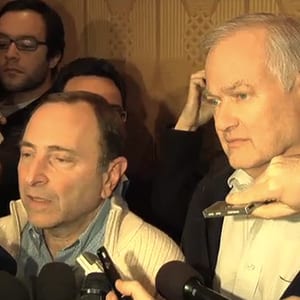
Hockey Lockout Appears Over As Tentative Deal Is Reached
-
Dale Perth

Fans of the National Hockey League should get ready for a short season — but at least it seems there will be some sort of season after all. Early on Sunday morning, an agreement in principle had been reached between the NHL and its players’ association for a new collective bargaining framework.
Details were sketchy as this story was posted, but it appears there will be a truncated season of between 48 and 50 games, with league play beginning perhaps as early as Tuesday, Jan. 15. At a hastily-called news conference after a 16-hour marathon negotiating session facilitated by mediator Scot Beckenbaugh, NHL commissioner Gary Bettman and NHLPA president Donald Fehr promised more details later in the day as paperwork is filed and approved. The commissioner noted that there is “still work to do,” including the process of getting the approval of the majority of both the owners and players.
The deal was struck after 113 days of often testy and rancorous negotiations. Although some details were unclear and still emerging at the time this article was written, some of the provisions in the new 10-year agreement include: a $60-million salary cap per team in the first season (pro-rated this season to $70 million) and $64.3-million in Year 2, with a team-salary “floor” of $44 million; an eight-year limit on contracts if a club re-signs one of its own players, and seven years if the player is coming from another team; 50/50 revenue-sharing at $200 million with a $60-million “growth fund”; and an opt-out clause for either side after the eighth year of the CBA.
Even if this consensus gets the required signoff by all parties, there is one important element to consider: how to win back the fans who have been alienated during the long and drawn-out affair. After Bettman told the assembled throng of media on Sunday morning that neither he nor Fehr would be taking questions, a reporter asked one anyway: “How will the league win back the fans?”
How, indeed? It’s going to take more than just inscribing “Thank You” on the ice at every arena in the league. There will have to be some work done to get the fans back to the game. Some never will, while others will return immediately; it’s the “mushy middle” which the league will have to focus on.
For what it’s worth, here’s a suggestion to avoid a repeat: set up a system similar to Major League Baseball where a “luxury tax” is instituted. It appears to be working for that league; Fehr knows all about it, since he helped negotiate the framework for that agreement which has led to labour peace in baseball for the past 17 years (not counting the MLB umpires’ walkout in 1999).
This, of course, will likely require an acknowledgement by both sides that they must stop pursuing strategies which are counter-productive to delivering the game to the fans. It hurts not just them, but the thousands whose livelihoods rely on the game. In other words: drop the puck, and don’t stop until the Stanley Cup is raised in June.