
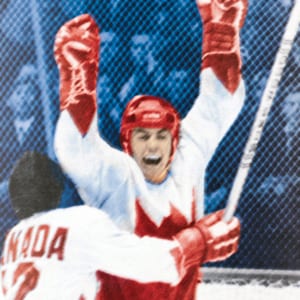
1972 Summit Series Still Packs a Punch for Hockey Fans
-
Dale Perth

Forty years ago, the Summit Series began with the Soviets stunning Canada and most of the hockey world with a 7-3 victory at the Montreal Forum in front of 18,818 fans. Prime Minister Pierre Elliot Trudeau dropped the ceremonial puck before the game; North American hockey fans’ jaws dropped at the end of it.
No one had ever seen anything like this. Of course, there was plenty of international hockey before the Summit Series of 1972: Canada had won a slew of gold medals at the Winter Olympics in preceding decades, and the World Hockey Championships have been held, on their own and as a part of the Olympics, since 1920. But nothing evoked the “Us vs. Them” mentality quite like the Summit Series.
The eight-game series was unique because for the first time, a competition featured a team of professionals from the National Hockey League playing on an international level against players representing what was then known as the Union of Soviet Socialist Republics (USSR). Canada had not been involved in international hockey for a few years, having withdrawn from the International Ice Hockey Federation over the issue of eligibility.
The dispute centred on the Soviet system of having players who were professional in every way but in name, being paid by the state to play the game essentially full-time for teams such as Central Red Army — the leadership of the USSR conferred military titles to players to make it appear as though they were “amateurs” playing part-time, but the reality was they were almost exclusively playing hockey in leagues and tournaments are were being paid by the state to do so.
From 1963 to 1976, the Soviets dominated the world hockey championships with their “part-time” professionals, while Canada’s amateur program languished in favour of professional tracks such as the major-junior and junior leagues. The IIHF and the International Olympic Committee rebuffed Canada’s request to use a mix of professional and amateur players, and Canada withdrew from Olympic and world competitions in 1970.
By 1972, though, with the spectre of the Cold War still looming over East-West relations, Summit Series organizers and USSR officials successfully negotiated an eight-game competition with Canada’s best players — all NHLers — against the cream of the Soviet regime. The first four games would take place in Montreal, Toronto, Winnipeg and Vancouver, with the final four being hosted in Moscow.
After that loss on Sept. 2, Canada would tie the series in Toronto with a 4-1 win a few days later. The teams then played to a 4-4 draw in Winnipeg before another disheartening 5-3 loss in Vancouver caused the fans to boo Team Canada, spurring forward Phil Esposito to launch an emotional defence of his team’s effort.
The USSR prevailed 5-4 in Game 5, but Canada would come back to win Games 6 and 7 by scores of 3-2 and 4-3. It went down to the eighth and final game at the Luzhniki Ice Palace in Moscow. In the last minute of regulation time with the score tied 5-5, forward Paul Henderson tallied what would be described as the “Goal of the Century” which would win the series for Canada 4-3-1. Hockey would never be the same.