
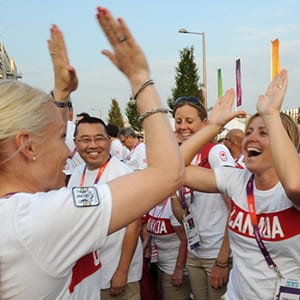
Canadian Contingent Aims for Top-12 Podium Finish
-
Dale Perth

The Canadian team has arrived at the 2012 Olympics in London. The flag has been raised at the athletes’ village in a ceremony attended by Governor-General David Johnston and the chef de mission, former gold-medal swimmer Mark Tewksbury. Now it’s time for the members to go forth and put their years of training, hard work and sacrifice into action.
So the pomp is out of the way, and the circumstance lies ahead. The party is started, and the sense of anticipation is hitting a fever pitch. The longer they can maintain that feeling, the better: Own the Podium has targeted a top-12 placing in the medal standings, and to say that it won’t be easy to accomplish is an understatement of Olympic proportions.
Canada placed 18th in 2008 at the Beijing Olympiad with 18 medals, tied for the third-highest medal count it has ever had at a Summer Games (Barcelona 1992: 18; Atlanta 1996: 22; Los Angeles 1984: 44). Sports Illustrated predicts Canada will win only 17 medals, with a mere three gold.
There is a handful of podium hopefuls: cyclist Ryder Hesjedal, shot-put specialist Dylan Armstrong, kayaker Adam van Koeverden, divers Jennifer Abel, Emilie Heymans and Alexandre Despatie, world-ranked tennis player Milos Raonic, trampolinist Karen Cockburn, triathletes Simon Whitefield and Paula Findlay, heptathlete Jennifer Zelinka, cyclist Clara Hughes, boxer Mary Spencer, wrestler Carol Huynh and show jumper Eric Lamaze are the most prominent names.
Since the competition is of a global nature, all of the 281 athletes in the contingent can expect to be pushed to the limit in the 24 sports they’re represented in — Canada has no teams in handball or field hockey. Using Beijing as a measuring stick, a 12th-place showing required 24 medals: Canada has only done that once, and that was in a year when the Soviets boycotted the Games.
A slow start is the Canadian way at Summer Olympiads, and so it is in London to this point. The official opening hasn’t even taken place yet — that happens on Friday, with Queen Elizabeth II in attendance — and already the Canadian women’s soccer squad lost on Wednesday to the World Cup champions from Japan 2-1 in Coventry. Generally Canada tends to do better in the second week of events, particularly rowing.
It’s already been a long and winding road for some of the athletes participating in London. Lamaze’s horse, Hickstead, died at a competition last year; Spencer needed a special exemption from the International Olympic Committee to go to London; Hesjedal had to withdraw from the Tour de France after being involved in an accident during the race.
Yet they’re all in England, hoping for the best; expectations are running high. In addition to the training, hard work and sacrifice, Canada’s athletes will need to employ another skill: managing their expectations.